The names of the two Golden snub-nosed monkeys born at Pairi Daiza revealed during the traditional 100-day ceremony.
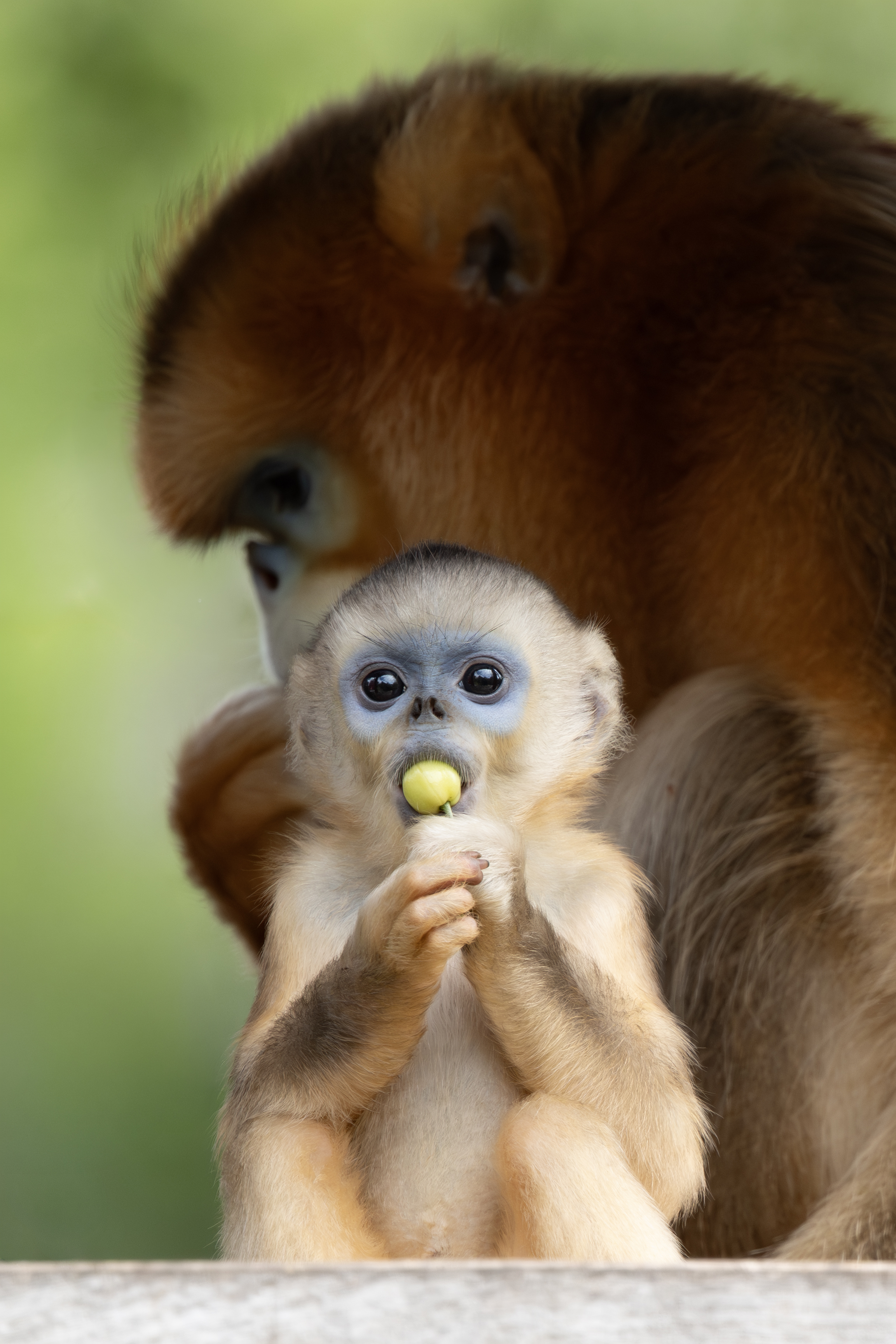
During the traditional Chinese 100-day ceremony, the sex and names of the two young golden monkeys were revealed.

They are both females, named Zhenzhen (珍珍) – a name evoking a young girl as sweet and radiant as a pearl – and Xi Le (喜乐), which means ‘joy’ and ‘simple happiness’.
In Chinese tradition, the 100-day ceremony symbolically marks the transition from a particularly vulnerable period in a newborn’s life to a new stage of greater strength, security and independence. This special occasion therefore provides an opportunity to celebrate the two exceptional births that took place on 17 March and 20 April this year.
Pairi Daiza invited visitors and fans to help choose the names, and they responded with tremendous enthusiasm and engagement: more than 8,600 votes were cast through the Park’s website.
The names were announced in the presence of His Excellency Fei Shengchao, Ambassador of the People’s Republic of China to the Kingdom of Belgium, Chinese experts, the Park’s teams and Eric Domb, Founder and Chairman of Pairi Daiza.


Two remarkable births for a rare species
The Golden snub-nosed monkey, or Roxellana’s rhinopithecus (Rhinopithecus roxellana), is one of the rarest and most protected primates in the world. Pairi Daiza is currently the only zoological institution in Belgium to house this species and one of the few in Europe to participate in its breeding programme. The births of Zhenzhen and Xi Le represent a major step forward for the international programme, carried out in close collaboration with the China Wildlife Conservation Association. They demonstrate the quality of the scientific, veterinary and daily animal care, as well as the trust that binds the Chinese and Belgian partners.
The two young females are now continuing to develop within their family group and will, in turn, grow into valuable ambassadors for their species.




Johan Vreys